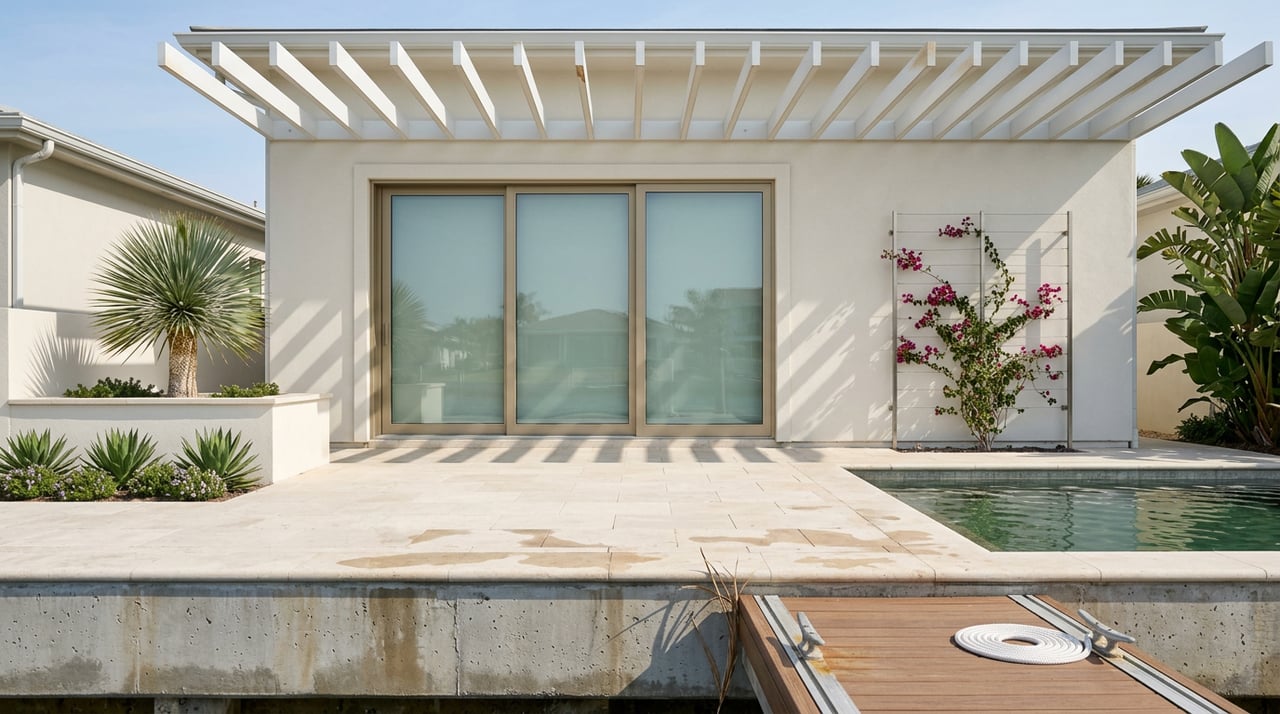
Do you own the dock behind your Newport Harbor home? Most buyers assume the answer is yes the moment they close. It usually is not.
In most of Newport Harbor, the water and the land beneath it are public tidelands held in trust for the State of California and managed by the City of Newport Beach. What actually conveys when a bayfront home sells is a residential pier permit, not a deed to the water. That distinction has always mattered on paper. In 2026 it matters in dollars, because the agency that oversees California's tidelands has just told Newport Beach its pier program is running below market rate, and the city is in the middle of rewriting the rules that govern it.
For a buyer or seller working through a Newport Harbor transaction right now, that timing changes what belongs in the purchase agreement and what belongs in the due diligence file.
What Transfers at Closing, and What Doesn't
A residential pier permit is issued to the owner of the abutting upland property, for a term of up to ten years. It attaches to the person and the parcel, not to the dock as a standalone asset, which means it does not follow the sale automatically the way title does.
The City of Newport Beach Public Works Department runs the transfer as its own process, separate from escrow paperwork. A transfer application with complete buyer and seller information, signatures due at close of escrow, along with the transfer fee, has to be submitted to the city. The pier gets inspected. Turnaround typically runs five to fifteen working days, after which the city sends a letter either confirming the dock met safety requirements or listing what needs correction before it will re-inspect. Only after the city receives original signatures from the seller, buyer, and any joint permittee does the permit actually change hands.
Skip that step, or treat it as a formality that will sort itself out after closing, and a new owner can end up holding a house with a dock that isn't legally theirs to use.
The Line in the Water That Sets the Ceiling on Value
Two lines determine what a Newport Harbor property can do with its water frontage, and they aren't negotiable at the local level. The bulkhead line marks where a deed typically stops and a permit begins. The pierhead line marks how far a structure can extend into the bay. In Lower Newport Bay, both were established by an act of Congress, which means they can only be changed by an act of Congress.
The distance between those two lines is, in practical terms, how much boat a property can hold. A parcel with 40 feet of clearance between bulkhead and pierhead is not a comparable asset to one with 75 feet, even when the houses and the frontage look identical on paper. A dock that already exists at a given size is generally worth more to a buyer than the theoretical ability to build one, since new dock approvals on already-developed stretches of the harbor are not routine.
That single measurement, more than square footage or even lot width, is why two homes on the same street can carry very different price tags once the water behind them is factored in.
The Rent That Hasn't Kept Up, and Why That's About to Change
Here is the part of the transaction most buyers never see coming. In December 2025, the California State Lands Commission reviewed how Newport Beach manages its tidelands and found that residential pier permit rates sit well below fair market value, a conclusion the Commission's chair, Lieutenant Governor Eleni Kounalaki, stated plainly during the meeting. The report also noted an odd asymmetry in how the city has handled its two waterfront rental programs.
| Water access type | Reported monthly rate |
|---|---|
| Offshore mooring, 40 feet, city rate as of early 2026 | About $133 (at $3.34 per linear foot) |
| Residential pier permit, reported range unchanged for years | About $12 to $30 |
| Private dock reported sublease rate, per boating industry accounts | Up to $12,000 |
Offshore moorings, which are essentially open-water parking spots reached by dinghy, have been reappraised on a regular schedule and priced to keep pace with market conditions. Residential piers attached to waterfront homes have not seen the same treatment. The state's report specifically flagged that the trend for pier permits has been to lower effective rent through reductions in calculated lease area rather than through updated appraisals, and it directed the city to commission a new independent appraisal, reconsider how pier rental area is measured, and review whether piers that homeowners sublease should be billed at commercial rates instead of residential ones.
The city has laid out a public timeline in response. New independent appraisals are underway through 2026. The first public meeting on the process was held May 27, 2026 at the OASIS Senior Center in Corona del Mar, with additional Harbor Commission meetings continuing into winter 2027. A draft policy package is expected in winter 2026 into 2027, with a comprehensive vote by the City Council to follow in 2027. The city has stated that no rate increases, transfer restrictions, or other policy changes take effect without Council approval and public notice, so nothing here is finalized. But a state agency has now put its findings on the record, and the direction of travel is clear enough that anyone buying today should plan around it rather than around the seller's current bill.
What This Means If You're Transacting on the Harbor Now
The practical move for a buyer is straightforward. Ask the seller for the current annual pier rent in writing, and treat that number as a starting point rather than a fixed carrying cost. If the plan is to sublease the dock, whether for boat storage income or as part of a leasing strategy on an investment property, that use is explicitly under review, and it's worth underwriting for a different fee structure before making an offer contingent on that income.
Sellers benefit from the same clarity in reverse. A pier permit in good standing, with a clean inspection history and no unresolved city correction notices, is a cleaner asset to hand off, and it shortens the post-offer surprises that can stall a bayfront closing.
Neither side should assume the current rent is a permanent feature of the property. It's a permit fee set by a public agency that has just been told, by a higher public agency, that it's too low.
The Paperwork That Slows Down Any Work in the Water
Beyond rent, any physical work on a dock, from a repair to a reconfiguration, runs through more than one agency. Eelgrass, specifically Zostera marina, and the invasive species Caulerpa taxifolia both trigger required survey protocols before in-water work can proceed, and where eelgrass is present, projects are typically redesigned to avoid shading it or mitigated at a set ratio. Dock and bulkhead work in the coastal zone generally also requires a Coastal Development Permit on top of the city's own building and harbor permits. None of that is a reason to avoid Newport Harbor waterfront. It's a reason to build the time and cost into a renovation budget rather than discovering it mid-project.
The harbor itself is also mid-transition on a larger scale. The Newport Harbor Dredging Project, a partnership between the city and the U.S. Army Corps of Engineers, is removing roughly 900,000 cubic yards of sediment from the harbor floor, restoring depth to federally authorized levels for the first time in decades. City officials have described it as the last comprehensive dredge planned for the harbor, following earlier work completed in 2012, with this phase expected to finish in fall 2026. For an owner or buyer thinking about vessel size and navigation in front of a specific property, that's useful context for a harbor that's changing shape this year, separate from anything happening at the individual dock level.
Frequently Asked Questions
Does the pier permit transfer automatically when I buy the house? No. It requires a formal application to the City of Newport Beach Public Works Department, signed by buyer and seller at close of escrow, along with a transfer fee and a city inspection.
Can I make my existing dock bigger? Only within the pierhead line, and extending beyond it requires Harbor Commission approval as the exception rather than the rule. The harbor lines themselves were set by Congress and can't be changed locally.
Are Newport Beach pier fees actually going up? Nothing has been finalized. The city has a public process underway through 2027, and it has stated no changes take effect without City Council approval and public notice. Given the State Lands Commission's December 2025 findings, buyers should plan for the possibility of an increase rather than assume today's rate holds.
Who is responsible for dredging in front of a bayfront home? The harbor permittee, meaning the homeowner, is generally responsible for the area between their side property lines extended into the bay and the federal project line. Citywide dredging, like the current Newport Harbor Dredging Project, is a separate, larger undertaking.
Newport Harbor rewards buyers and sellers who read past the listing photo of the dock. If you're evaluating a bayfront property, or deciding whether now is the right time to bring one to market while the city's pier policy is still being written, Kathy Samuel can walk through the permit, the pricing, and what the current regulatory moment actually means for your transaction. Request a Private Home Valuation to start that conversation.